
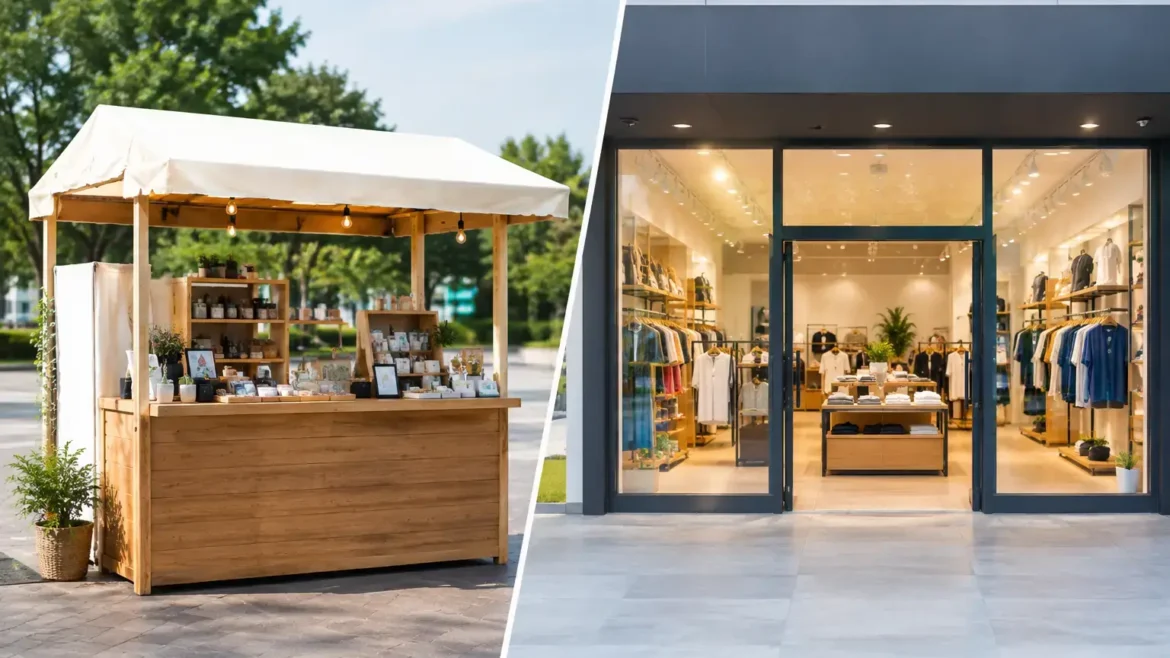
A premium retail opportunity can disappear while a permanent store is still waiting for approvals, fabrication, and fit-out. That is why the decision around كشك مؤقت مقابل متجر دائم is not simply about size. It is a commercial choice about speed, risk, customer behavior, brand visibility, and how confidently your business can commit to a location.
For retailers, food concepts, beauty brands, service providers, and property activations, both formats can produce strong results. The right answer depends on what you need the physical space to accomplish now and what evidence you have that the opportunity will last.
Temporary Kiosk vs. Permanent Store: Start With the Business Case
A temporary kiosk is built for momentum. It puts a brand into a mall, exhibition, seasonal event, airport, or high-footfall commercial space without the cost and long-term commitment of a full retail unit. It can be a compact sales point, a product demonstration station, a lead-generation activation, or a focused pop-up designed around one hero category.
A permanent store is built for depth. It gives customers a full brand environment, broader inventory, private consultation areas, better storage, and a more complete service experience. For businesses with reliable demand and a defined retail strategy, it becomes an operating asset rather than a short campaign.
The wrong question is, “Which one looks more established?” A custom-built kiosk can look highly polished and commercially credible. The better question is, “What must this location prove or deliver before we commit more capital?”
| Decision factor | Temporary kiosk | Permanent store | | — | — | — | | Launch timeline | Usually faster once approvals and design are finalized | Longer due to fit-out scope, landlord requirements, and site work | | Initial investment | Lower and easier to control | Higher, with more construction and operational costs | | Brand experience | Focused and high-impact | Immersive, with more room for storytelling and service | | Location flexibility | Can move, adapt, or be retired after a campaign | Tied to a lease and a fixed footprint | | Inventory capacity | Best for curated ranges | Better for extensive inventory and back-of-house needs | | Market testing | Excellent for validating demand | Better when demand is already proven |
When a Temporary Kiosk Is the Smarter Move
A temporary kiosk is often the strongest choice when the brand is testing a new customer segment, entering a new mall, launching a seasonal range, or introducing a product that benefits from live demonstration. It creates a visible market presence without requiring the business to build an entire retail operation around an unproven site.
This format works especially well when the offer is easy to understand within seconds. Fragrance, cosmetics, accessories, specialty food, mobile services, gifting, beverages, and product personalization can all perform well from a kiosk when the layout makes the interaction clear. The customer should see the product, understand the value, and know where to stand or pay almost immediately.
Speed is another advantage. A kiosk can move from concept to installation more efficiently than a full store because the footprint is smaller and the construction scope is more controlled. That does not mean it should be treated as a lightweight project. Mall guidelines, electrical points, fire and safety requirements, storage access, signage rules, and operating permissions still need to be addressed early.
For many brands in Dubai and across the UAE, a kiosk also functions as a live research tool. Sales data shows which products stop traffic. Staff feedback reveals common customer objections. Footfall patterns help identify peak trading hours. Those insights are far more useful than assumptions made before opening.
A kiosk succeeds when it is designed to sell, not just display
A beautiful kiosk that blocks circulation, hides its products, or gives staff no workable counter space will struggle in a high-traffic environment. Design must account for customer flow from every visible side, sightlines from nearby corridors, clear product hierarchy, lighting, concealed storage, and durable finishes that can withstand daily use.
Branding has to work at distance and close range. From across the mall, shoppers should recognize the brand and offer. At the counter, they should find enough detail to make a confident purchase. This is where custom fabrication matters: the display, joinery, lighting, and branded surfaces should operate as one retail system rather than as separate decorative parts.
When a Permanent Store Makes Better Commercial Sense
A permanent store is the better investment when your brand needs time and space to build trust. Higher-consideration products, broad collections, premium services, consultations, and multi-step customer journeys rarely fit comfortably into a compact kiosk footprint.
A full store also supports operational control. You can create dedicated stock areas, fitting rooms, treatment spaces, consultation zones, staff facilities, and merchandising walls that change with collections or promotions. This flexibility supports stronger average transaction values and repeat visits, particularly when customers expect a more personal experience.
The permanent format becomes more viable when three conditions are present: the location has dependable traffic, the sales model has been validated, and the lease period gives the brand enough time to recover the fit-out investment. If one of those conditions is weak, a staged kiosk strategy may be the more disciplined choice.
Permanent retail fit-outs require more coordination because every detail affects both compliance and daily operations. Flooring transitions, HVAC interfaces, shopfront design, lighting levels, electrical loads, signage, accessibility, storage, and landlord handover requirements need to work together. Delays often happen when design intent and site realities are handled by separate parties without clear responsibility.
An end-to-end contractor reduces that risk by managing design development, in-house fabrication, site coordination, construction, and installation as one connected project. For a permanent store, consistency in execution is just as valuable as a strong creative concept.
Budget Beyond the Build Cost
Comparing only the initial quote can lead to the wrong decision. A temporary kiosk may cost less to manufacture, but it may also have higher logistics, staffing, short-term leasing, or repeated activation costs. A permanent store requires a larger upfront commitment, yet it can support a broader product range and lower the need for frequent rebuilds.
Consider the full commercial picture: lease obligations, mall service charges, staffing, stock holding, utilities, maintenance, marketing, insurance, permits, refurbishment cycles, and the expected revenue per square foot. A compact kiosk with high turnover can outperform a large store with weak conversion. A well-located store with a service-led model can outperform a kiosk even with a higher operating cost.
There is also a reuse question. A custom kiosk should be engineered for disassembly, transport, and reinstallation if the brand intends to use it across multiple venues. Reusable components, replaceable graphic panels, durable counters, and adaptable display modules can extend the life of the investment well beyond one campaign.
A Practical Way to Make the Decision
Choose a temporary kiosk if the goal is to validate a location, generate immediate sales around a focused offer, support an event, or create a flexible retail entry point. Choose a permanent store if your brand requires deeper product discovery, reliable back-of-house capacity, private service areas, and a long-term destination for customers.
There is also a middle path. Many successful retailers begin with a kiosk, measure performance for several months, then use the evidence to negotiate and design a permanent store. Others maintain kiosks in strategic malls while using one flagship store as the complete brand experience. These formats do not have to compete. They can perform different jobs within the same retail strategy.
Creative Roots approaches both projects as commercial environments, not off-the-shelf structures. Whether the brief calls for a branded pop-up or a full retail fit-out, the priority is the same: build a space that catches attention, supports staff, meets site requirements, and gives customers a clear reason to engage.
The strongest retail move is the one that matches your current certainty. Build a kiosk when you need proof, agility, and visibility. Build a permanent store when the location, customer demand, and operating model have earned a longer commitment.