
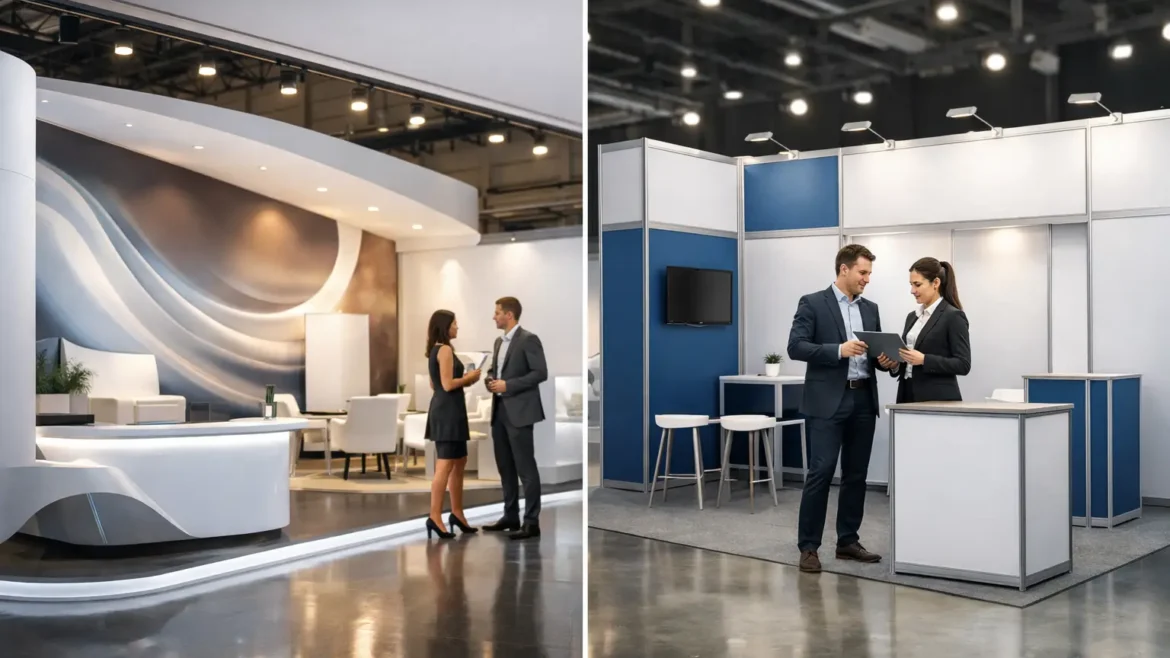
The floor plan is approved, the exhibition date is approaching, and one decision will shape how visitors experience your brand: custom stands versus modular booths. This is not simply a question of appearance. It affects visitor flow, build time, transport, staffing, reuse, and the commercial impact you can expect from the event.
For exhibitors in Dubai, Abu Dhabi, Sharjah, and across the UAE, the right answer depends on the purpose of the show. A product launch, a high-value lead-generation event, and a recurring regional exhibition schedule each call for a different type of environment. The best booth is the one that supports the job your team needs it to do.
Custom Stands Versus Modular Booths: The Core Difference
A custom stand is designed and built around a specific brand, floor plan, campaign, and visitor experience. Its structure can include bespoke joinery, shaped walls, feature ceilings, integrated LED screens, product displays, meeting rooms, storage, hospitality counters, and lighting designed for the exact space. It is built to make a distinct statement rather than fit a preset system.
A modular booth uses standardized, reusable components that can be configured in different layouts. Panels, frames, shelving, counters, graphics, and lighting are assembled to suit the footprint. A well-designed modular system can still look polished and branded, but its architecture follows the limits of the components available.
Neither route is automatically better. Custom design gives a brand more freedom. Modular construction can offer greater efficiency and predictability. The choice comes down to how much differentiation, flexibility, and reuse your exhibition program requires.
When a Custom-Built Stand Makes Business Sense
Custom stands are built for moments when visibility has a direct commercial value. If your company is introducing a flagship product, hosting serious client meetings, competing in a busy hall, or representing a premium brand, a tailored environment can create the right level of authority before a conversation even begins.
The biggest advantage is control. Instead of adapting your story to a standard booth frame, the stand is planned around your objectives. A technology company may need a live demonstration zone, a hospitality brand may need a lounge that feels like part of its venue, and a real estate developer may need private tables for detailed sales discussions. These are very different requirements, and a custom build can organize them without making the space feel crowded.
Custom fabrication also allows the details to carry the brand. Material finishes, curved forms, illuminated features, raised platforms, digital touchpoints, and precise product presentation can work together as one environment. For businesses that compete on quality, innovation, or high-end service, those details are not decoration. They signal what kind of company visitors are dealing with.
There are trade-offs. A bespoke stand typically requires more design development, approvals, fabrication time, and upfront investment. It can also be less practical to reuse without adaptation, especially if the next event has a very different footprint. That does not mean it is a one-time asset. Elements such as counters, branded walls, displays, screens, and furniture can often be planned for future use, but this should be addressed at the first design consultation.
Choose custom when the event is high stakes
A custom-built stand is usually the stronger choice when the exhibition is a major revenue opportunity, your booth location needs to stop traffic, or the brand experience cannot be reduced to graphics on a standard shell. It also makes sense when you need enclosed meeting space, controlled demonstrations, unusual product displays, or a structure that feels closer to a retail or hospitality interior than a temporary booth.
For these projects, execution matters as much as the concept. Venue regulations, electrical planning, fire and safety requirements, access hours, transport, and installation crews all need to be coordinated early. An experienced exhibition stand builder can manage those moving parts while keeping the finished space aligned with the approved design.
Where Modular Booths Deliver Real Value
Modular booths are a smart choice for companies that exhibit frequently, work with repeatable stand sizes, or need to balance presentation quality with strict cost control. Because the core structure is reusable, the investment can be spread across several shows rather than concentrated in one major activation.
This is particularly useful for brands with a calendar of smaller exhibitions, roadshows, conferences, or mall activations. The framework can remain consistent while graphics, shelves, product messaging, and layout components change from one event to the next. That gives the team a recognizable brand presence without beginning from zero every time.
Speed is another advantage. Once the system and graphics are ready, modular booths can generally be assembled faster than a fully bespoke structure. For a late event confirmation or a compact exhibition footprint, this can reduce pressure on both the marketing and procurement teams.
The limitation is visual sameness. If a modular booth relies too heavily on basic panels, pull-up graphics, and standard furniture, it can blend into the aisle. The answer is not always to abandon the modular approach. It is to use better graphic planning, purposeful lighting, branded counters, display zones, and a layout that creates a clear reason for visitors to step inside.
Choose modular when reuse is the priority
A modular solution is often the best fit when your team attends multiple shows each year, the booth footprint changes only slightly, and the primary need is a clean, professional, repeatable presence. It is also practical for early-stage exhibitors that need to test events before committing a larger portion of their budget to a custom build.
Storage should be part of the calculation. Reuse only creates value if the components are cataloged, protected, transported, and maintained between events. Before approving a modular system, confirm who will store the structure, how replacement graphics will be produced, and whether the system can expand from a small inline booth to a corner or island configuration.
Compare the Budget Beyond the First Quote
The lower initial quote is not always the lower total cost. A modular booth may cost less for the first event and become increasingly cost-effective over several uses. A custom stand may have a higher initial investment but produce more leads, stronger meetings, more press attention, or better product engagement at a critical show. The commercial return matters more than the construction category alone.
When comparing proposals, look at what is included. Design, 3D visualization, production drawings, fabrication, branded graphics, lighting, furniture, AV coordination, transport, installation, dismantling, and venue paperwork can all affect the real project cost. A low figure that excludes key requirements can quickly become expensive once deadlines are close.
Also consider the cost of a weak first impression. In a crowded exhibition hall, visitors make fast decisions about where to stop. If your sales team is carrying a major launch, a compact booth with little visual hierarchy may limit the opportunity before the pitch begins.
A Hybrid Approach Can Be the Best Fit
The most practical answer is often not strictly custom or strictly modular. A hybrid booth can use a reusable framework for the main structure, then add custom-built feature pieces for the event’s main attraction. This could mean a bespoke reception counter, a sculptural product wall, a branded demonstration station, or a premium meeting area attached to a modular base.
This approach gives businesses a way to maintain efficiency without appearing repetitive. It is especially effective for brands that exhibit across different venue sizes but want one recognizable design language. The reusable elements protect the long-term budget, while the custom components keep the presentation fresh and relevant.
At Creative Roots, this kind of decision is approached from both sides: the creative ambition of the space and the practical reality of fabrication, delivery, installation, and future use. That integrated view helps avoid designs that look impressive in a rendering but create unnecessary complications on the exhibition floor.
Make the Decision Before Design Starts
Start with the event objective, not with a preferred construction method. Define who you need to attract, what action you want visitors to take, how many staff will work the booth, and whether the stand must serve future events. Then assess the venue footprint, lead time, budget range, and storage plan.
If the event needs a distinctive destination that carries a major brand message, invest in a custom-built environment. If your business needs an efficient exhibit system that can work hard across a full calendar, modular construction may deliver better value. And if you need both, build a hybrid plan that gives your brand a strong centerpiece without wasting reusable assets.
The right booth should make your team more effective on the floor. Plan it around the conversations, demonstrations, and sales moments you want to create, and the build choice becomes far clearer.