
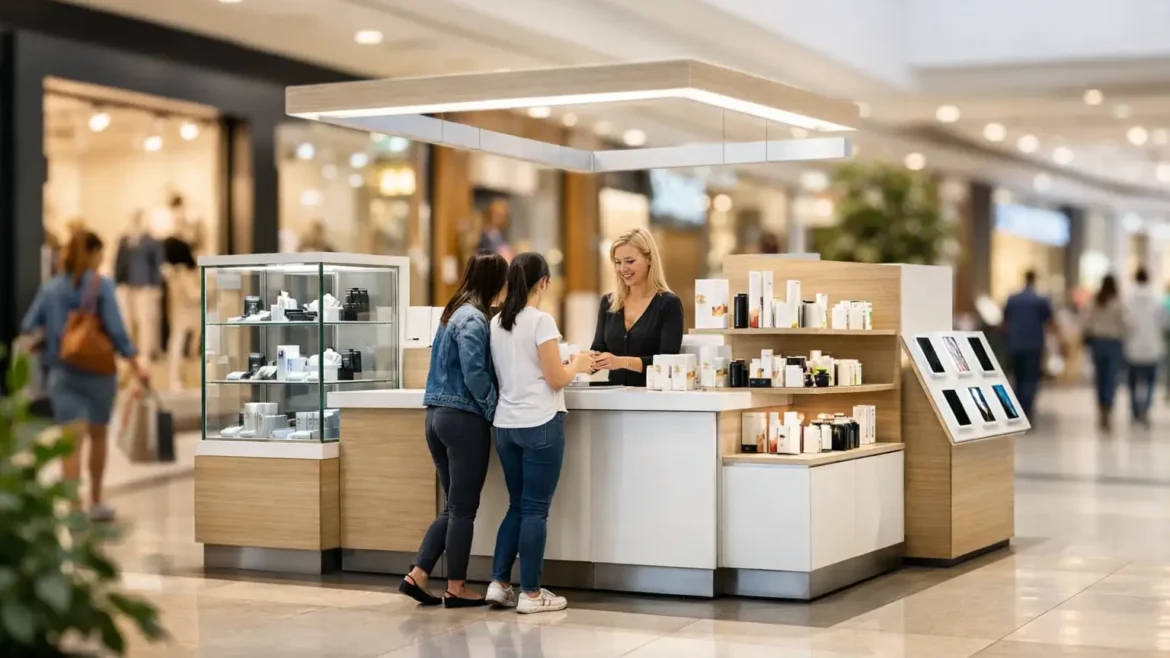
A mall kiosk has only a few seconds to earn a shopper’s attention. It must communicate what the brand sells, invite people closer, support a quick transaction, and keep working through long operating hours. Effective retail kiosk design for malls is not simply a compact version of a retail store. It is a purpose-built sales environment where visibility, customer flow, staff comfort, storage, and mall compliance all need to work together.
For retail operators, brand managers, and property teams, the strongest kiosks are designed around a commercial question: what does a customer need to see, touch, sample, or understand before they buy? The answer should shape every decision from the kiosk footprint to the placement of a payment terminal.
Start With the Sales Model, Not the Render
A visually impressive kiosk can still underperform if it does not support the way the business actually trades. Before design begins, define the customer journey in practical terms. Is the kiosk selling quick-grab accessories, personalized gifts, beauty products, food and beverages, telecom services, or premium items that require consultation? Each model demands a different layout.
A high-volume coffee or snack kiosk needs a production sequence that prevents staff from crossing paths: order, payment, preparation, collection. A cosmetics kiosk may need open product discovery, mirrors, testers, and a more private consultation point. A jewelry or electronics kiosk needs controlled display cases, secure storage, and clear sightlines for staff.
This is where a custom-built approach pays off. Instead of forcing operations into a generic counter unit, the kiosk can be planned around the exact equipment, product range, staffing level, and anticipated queue. The result is a space that looks branded because it works like the brand works.
Retail Kiosk Design for Malls Needs a Strong First Read
Mall shoppers are surrounded by signage, storefronts, promotions, and movement. A kiosk cannot rely on a long explanation. Its offer must be understood at a glance from several directions.
The best first read usually comes from a disciplined hierarchy. Your brand name should be visible at the right height. The hero product or service should occupy the strongest visual zone. Then, a simple message such as “Personalized While You Wait” or “Freshly Made” can explain the reason to stop. When every surface carries competing graphics, the kiosk becomes harder to read, not easier to notice.
Material choice matters as much as graphics. Illuminated acrylic, textured laminates, timber finishes, powder-coated metal, backlit fabric, and laser-cut details can give a kiosk presence without making it feel oversized. For a premium brand, restrained detailing and high-quality joinery may create more confidence than oversized signs. For youth-focused retail, bolder color blocking, digital displays, and interactive elements may be the better fit.
The trade-off is maintenance. Gloss finishes show fingerprints. Open shelving can look inviting but demands constant merchandising. Complex lighting adds visual impact but should be specified with accessible components for easy replacement. Good design accounts for the appearance of the kiosk at opening time, during peak footfall, and after a long day of trading.
Design for 360-Degree Traffic
Unlike a conventional store, a mall kiosk is often viewed from all sides. That changes how the structure should be planned. A beautiful front elevation is not enough when the back panel faces an escalator or a main mall corridor.
Think of the kiosk as a three-dimensional brand object. Every public-facing side should have a purpose, whether that is product display, a campaign message, a digital screen, a service counter, or a carefully finished architectural surface. Avoid creating a dead side that looks like unfinished storage or exposes cables, equipment, and staff clutter.
Traffic flow should determine where customers pause and where staff serve them. If the main corridor moves from left to right, the primary entry or service point may need to face that direction. If the kiosk sits near a cinema, supermarket, or escalator, the typical pace and behavior of passersby will be different. Fast-moving traffic needs a bolder visual cue. A destination zone can support deeper browsing and more product storytelling.
Queue management is equally important. A line of customers should not block neighboring retailers, fire routes, or the natural circulation of the mall. In some cases, a compact queue rail, clearly marked collection point, or separate order and pickup locations can protect the customer experience during busy periods.
Fit More Function Into Less Space
Kiosk projects succeed or fail on the details hidden behind the display. Storage, electrical access, refrigeration, POS equipment, water connections, waste management, and cleaning supplies all need a planned home. If they are treated as afterthoughts, the operating counter becomes cluttered within days.
A productive kiosk usually separates customer-facing display from staff-only functions. Drawers and under-counter cabinets can store fast-moving stock. Lockable compartments protect valuable inventory. Integrated cable management keeps POS terminals and chargers organized. Ventilation, power load, and equipment clearances must be resolved before fabrication, especially for food, beverage, and technology concepts.
Staff ergonomics deserve the same attention. Counter heights should suit the tasks being performed. Frequently used products should be within easy reach. Doors should open without blocking circulation. A kiosk that saves a few inches on paper but forces staff to bend, turn, and reach all day will slow service and increase fatigue.
Storage Is Part of the Customer Experience
Many operators underestimate daily replenishment. If a kiosk cannot hold enough stock for peak hours, staff will make repeated trips to the mall storeroom or leave boxes visible on the floor. Both affect sales and presentation.
The right storage capacity depends on product size, delivery frequency, security requirements, and lease conditions. It may be better to use a slightly taller enclosed display or a carefully planned rear cabinet than to sacrifice operational control for an overly minimal look.
Build for Mall Requirements From Day One
Mall management teams typically review kiosk drawings, materials, branding, electrical plans, safety features, and installation procedures. Requirements vary by property, but the common goal is clear: the kiosk must be safe, durable, accessible, and appropriate for a high-traffic public environment.
That means design cannot be separated from engineering and fabrication. Fire-rated or approved materials may be required. Electrical systems must be safely integrated and accessible for inspection. Edges, glass elements, signage height, lighting brightness, and floor protection may all be reviewed. If the kiosk includes food preparation, additional hygiene, plumbing, extraction, or equipment requirements may apply.
For projects in Dubai and across the UAE, local mall approvals and site rules can influence the final design just as much as the brand brief. An experienced kiosk manufacturer addresses these constraints early, reducing the risk of redesigns, delayed installation, or expensive changes once fabrication has started.
Choose Materials That Match the Operating Reality
A kiosk is touched hundreds of times a day. It is cleaned regularly, moved into position during restricted access hours, and exposed to carts, bags, and constant public contact. Materials should be selected for more than visual appeal.
Solid-surface counters are a practical option where hygiene and easy cleaning matter. Laminated MDF can provide a broad range of finishes at a controlled cost, provided edges and high-contact areas are properly protected. Metal frames add strength for larger structures and can support a more industrial or premium aesthetic. Glass creates openness for products but needs careful detailing, safety specification, and a realistic cleaning plan.
There is no single best material package. A short-term activation may justify lighter, modular construction. A long-term lease may need heavier-duty joinery, replaceable panels, and durable hardware. The key is matching the build specification to the commercial lifespan of the kiosk.
Make Technology Useful, Not Decorative
Digital screens, interactive menus, charging points, QR-based catalogs, and LED features can help a kiosk attract attention. But technology should reduce friction or improve storytelling. A screen that only repeats a logo adds little. A screen that shows live product options, wait times, customization choices, or promotional bundles can actively support conversion.
Technology also needs practical support. Screens need secure mounting and service access. Lighting should not create glare on products or payment terminals. Power requirements must be calculated before installation. The more integrated the technology, the more valuable in-house design, fabrication, and technical coordination become.
Turn the Kiosk Into a Repeatable Brand Asset
The strongest kiosk is not a one-off structure that looks good only on launch day. It is a repeatable brand asset that can support promotions, seasonal campaigns, product updates, and potentially new mall locations. Consider interchangeable graphic panels, adjustable shelving, replaceable display trays, and lighting zones that can be updated without rebuilding the full unit.
Creative Roots approaches custom mall kiosks as turnkey retail builds – combining concept development, detailed design, in-house fabrication, branding, delivery, and on-site installation. That connected process helps protect the original idea while ensuring the finished kiosk is ready for real mall operations.
Before approving a final design, stand in the customer’s position. Can they identify the offer immediately? Can they approach without confusion, browse without obstruction, and pay without delay? Can your team replenish stock, serve peak traffic, and close down securely? When the answer is yes, the kiosk is ready to do more than occupy space – it is ready to earn its place in the mall.