
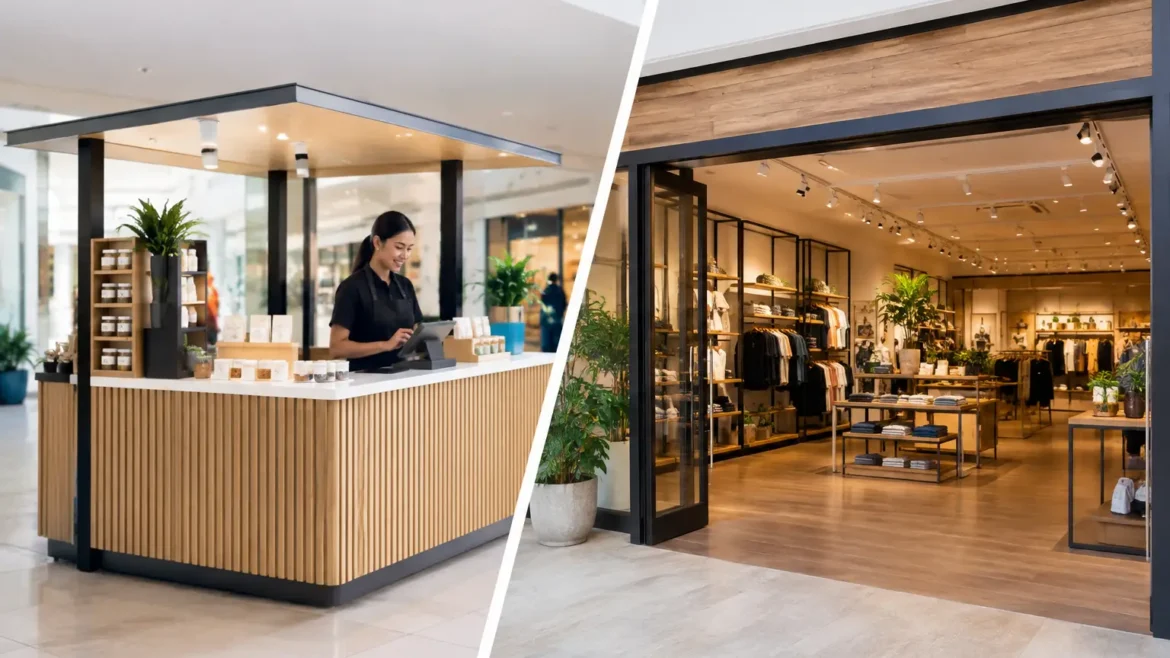
A retail kiosk versus inline store decision is not simply about choosing a smaller or larger footprint. It determines how customers discover your brand, how much inventory you can carry, the pace of construction, staffing needs, lease exposure, and the kind of retail experience you can create. For brands entering a mall, testing a concept, or expanding across the UAE, getting the format right before signing a lease can protect both budget and growth potential.
Retail Kiosk Versus Inline Store: The Core Difference
A mall kiosk is a compact, open-format retail unit positioned in a common area, often along a mall walkway, atrium, or high-traffic junction. It is designed to stop passing shoppers quickly. Its structure, counters, lighting, signage, product displays, and storage are custom-built around a limited footprint and a highly visible brand message.
An inline store is a fully enclosed retail space located within a row of shopfronts. It has a dedicated entrance, frontage, walls, back-of-house space, and more freedom to create an immersive customer journey. An inline unit can support a wider product range, consultation areas, fitting rooms, demonstrations, or service counters that need privacy.
Neither option is automatically better. A kiosk is often the sharper commercial move for brands selling fast, visual, giftable, or easily demonstrated products. An inline store tends to suit businesses that need depth of assortment, longer dwell time, or a more controlled environment.
When a Retail Kiosk Makes Commercial Sense
The strongest advantage of a kiosk is exposure. With open sides and direct visibility from multiple approaches, shoppers can see the product and the team before they make a deliberate decision to enter. This is valuable for impulse-led categories such as accessories, beauty products, specialty food, mobile accessories, fragrance, gifts, and fast product personalization.
A kiosk can also shorten the path from approval to launch. Compared with a full shop fit-out, the design and fabrication scope is more focused. A well-planned custom kiosk can integrate display shelving, lockable storage, POS areas, branded lightboxes, electrical points, and product sampling zones without wasting a single usable surface.
For a new retail concept, the smaller commitment is equally important. A kiosk gives operators a practical way to test a mall location, observe customer behavior, refine merchandising, and prove demand before investing in a larger store. The lower total fit-out scope can free capital for inventory, launch campaigns, staffing, or a second location.
That said, smaller does not mean simple. A mall kiosk has to work hard. Poor circulation, inadequate storage, oversized branding, weak task lighting, or an exposed cable layout can make a compact unit feel cluttered and unprofessional within days of opening. Custom design matters because every counter edge, shelf, drawer, and sign must earn its place.
When an Inline Store Is the Better Investment
An inline store gives a brand room to build an environment, not just a transaction point. The customer crosses a threshold, moves through a planned layout, and experiences the brand through finishes, displays, lighting, fragrance, music, product stories, and service. That control is especially useful when trust, consultation, or product comparison affects the sale.
Consider categories such as fashion, eyewear, jewelry, home products, specialty electronics, wellness services, salons, premium beauty, and larger food concepts. These businesses often need more storage, a larger stockroom, product trial areas, or a private setting for conversations. An inline unit can also accommodate higher-value merchandising without exposing every item to public circulation.
The format supports stronger upselling because customers have more time and space to browse. A well-executed retail fit-out can guide them from a hero display to complementary products, seasonal collections, consultation zones, and checkout. It also provides greater flexibility for changing campaigns, hosting small activations, and expanding product categories over time.
The trade-off is a larger commitment. Inline stores generally require more detailed approvals, MEP coordination, civil work, joinery, flooring, ceilings, signage, fire and safety compliance, and longer site installation. The rent, service charges, staffing, inventory levels, and maintenance requirements may be higher as well. A large store with insufficient footfall or a weak assortment becomes expensive quickly.
Compare the Numbers Before You Compare the Look
Design should make a retail format perform, but the commercial model must lead the decision. Before committing to either route, estimate sales capacity rather than relying only on a mall’s headline footfall.
Start with the expected number of transactions per day, average transaction value, gross margin, operating hours, employee requirements, and monthly occupancy cost. A kiosk may generate fewer high-ticket sales but can produce excellent revenue per square foot when the offer is immediate and the location is active. An inline store may need a higher revenue target, yet it can support a larger basket size and better repeat purchasing.
Also assess what the customer must do before buying. If they can understand the product in ten seconds and purchase within a minute, a kiosk may be ideal. If they need to compare options, try products, ask detailed questions, or spend time with a consultant, an inline store gives the sale the space it needs.
The right question is not, “Which format looks more premium?” It is, “Which format removes the most friction from our specific sale?”
Location Changes the Answer
A kiosk at the entrance to a major anchor store, near a cinema, beside an escalator, or along a busy dining route can outperform a poorly positioned inline unit. High visibility is the kiosk’s engine, so sightlines and pedestrian movement should be studied before design begins. A kiosk placed where shoppers only pass from one side needs a different facade and display strategy from one located in the center of a circulation zone.
For inline stores, frontage width, neighboring brands, distance from anchors, floor level, and line of sight from the mall corridor all affect performance. A narrow front with a deep store can work for destination shopping but may struggle with impulse discovery. Large glazed frontages and a clear visual focal point help invite customers inside.
In Dubai and across the UAE, mall management requirements also influence the build. Approved materials, height limits, signage rules, power loads, storage restrictions, access schedules, and fire-safety standards need to be considered early. Working with a contractor that can design, fabricate, coordinate, and install under one project plan reduces handoffs that can delay opening day.
Design Priorities for Each Format
A kiosk must communicate fast. Branding should be recognizable from a distance, but product should remain the focal point at close range. Use layered lighting, accessible displays, concealed storage, durable worktops, and a checkout position that does not block browsing. The team needs enough room to serve customers efficiently without turning their backs on the walkway.
An inline store needs a more deliberate journey. The entrance should reveal a clear hero moment, while the layout should lead shoppers naturally toward key categories and the point of sale. Back-of-house planning is just as important as front-of-house finishes. Receiving, stock storage, staff movement, cleaning access, and maintenance all affect daily performance.
For either format, avoid treating the fit-out as a decorative expense. Fixtures should support restocking, product security, durability, and campaign changes. A beautiful display that cannot be cleaned, repaired, or re-merchandised efficiently creates operational problems after launch.
A Practical Decision Framework
Choose a kiosk when your brand benefits from fast visibility, compact inventory, short transactions, product demonstration, and a lower-risk market entry. Choose an inline store when your offer requires privacy, depth of assortment, a longer sales conversation, a controlled environment, or substantial back-of-house operations.
There is also a middle path. Some brands begin with a bespoke kiosk to validate a mall, then move into an inline store once sales patterns and customer demand are proven. Others use an inline flagship as the main brand environment while kiosks operate as seasonal, promotional, or location-specific sales points.
Creative Roots plans and builds both custom mall kiosks and turnkey retail fit-outs, helping brands turn the chosen format into a practical, market-ready space. The most effective retail unit is the one that matches how your customers already want to buy, then gives them a compelling reason to stop, stay, and return.