
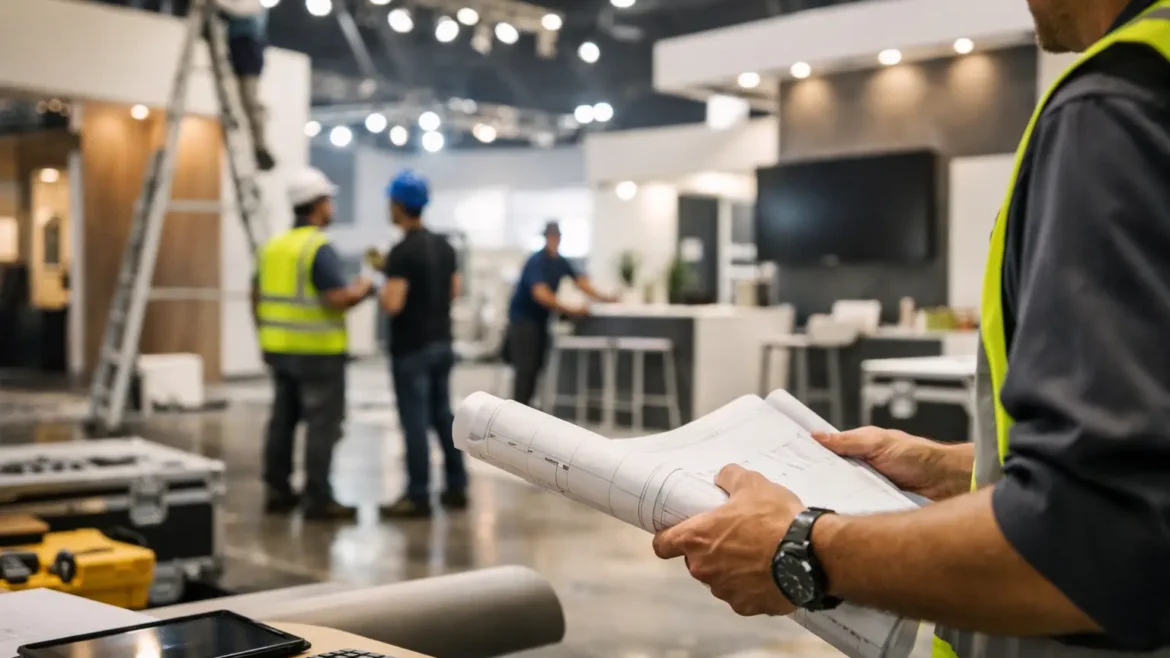
A trade show stand has only seconds to earn attention on a crowded floor. That is why exhibition fabrication companies are not simply suppliers of walls, counters, and graphics. The right partner turns a brand brief into a physical environment that attracts the right visitors, supports productive conversations, and arrives on site ready for opening hour.
For exhibitors in Dubai and across the UAE, the commercial pressure is real. Floor space, event logistics, staffing, and travel all carry a cost. A generic booth can meet the venue requirement, but a custom-built stand should do more: clarify what the brand offers, create a reason to stop, and give the sales team a space built for meaningful engagement.
What Exhibition Fabrication Companies Actually Do
The strongest exhibition fabrication companies manage the practical gap between a creative idea and a stand that can be safely built, transported, approved, and installed. Their work begins well before a workshop starts cutting materials.
A typical project includes concept development, 3D stand design, technical drawings, material selection, fabrication, printing, electrical coordination, venue documentation, transport, installation, and dismantling. When these functions are handled by separate vendors, small gaps can quickly become expensive problems. A graphic panel may not fit the final frame. A feature wall may require a structural adjustment. A late venue request may leave nobody clearly accountable.
Turnkey delivery puts design and execution under one project lead. That does not mean every stand needs to be complicated. In fact, the best solution is often the one that uses the budget with discipline: high-impact focal points where visitors first look, practical storage where staff need it, and durable finishes where guests will touch the stand all day.
Design Must Work Beyond the Render
A polished render is useful, but it is not the finished product. It must translate into a buildable stand with realistic dimensions, clear visitor circulation, correct sightlines, and enough power for screens, lighting, product displays, and charging points.
This is where technical experience matters. A large overhead element may look impressive but trigger venue restrictions or increase installation time. A fully enclosed meeting room may offer privacy but block sightlines and make a compact stand feel closed. Premium finishes can elevate a brand presence, yet some need careful handling during transport and repeated assembly.
Good fabrication teams discuss those choices early. They protect the design intent while explaining what will affect cost, timing, longevity, and on-site practicality.
How to Choose an Exhibition Fabrication Partner
The right partner is not always the company with the most dramatic portfolio image. The better question is whether it can deliver your specific stand within the event timeline, venue rules, and commercial objective.
Start by sharing the details that shape the project: exhibition name and dates, stand size, open sides, brand guidelines, target audience, products to display, and the outcome you want from the event. Lead generation, product launches, distributor meetings, hospitality, and brand awareness each call for a different layout.
A focused brief produces a better proposal than asking for a stand that is simply “modern” or “eye-catching.” For example, a business showcasing machinery may need open access, reinforced display platforms, and digital demonstrations. A luxury retail brand may prioritize controlled lighting, refined finishes, and consultation zones. A technology company may need cable management, screen placement, and a fast visitor journey for demos.
Look for In-House Fabrication Capability
In-house manufacturing gives an exhibition contractor greater control over quality, finish consistency, and production schedules. It also makes problem-solving faster when a design needs an adjustment before delivery or a last-minute component must be remade.
Ask where the stand will be fabricated, who manages production, and whether the team handles joinery, metalwork, printing, painting, and branded display elements directly. Not every component must be made under one roof, but clear ownership matters. A contractor that coordinates its suppliers well can also deliver excellent results. What matters is that one accountable team owns the final outcome.
For UAE events, local production has another practical advantage: it reduces the risk and lead time associated with international shipping, customs delays, and imported replacement parts. This is particularly valuable for custom stands with tight exhibition schedules.
Review Build Quality, Not Only Design Style
Portfolio images reveal visual range, but they do not always show what happens behind the finished walls. During a consultation, ask about the materials proposed, the finish level, the structural approach, and the plan for installation.
A well-built stand should feel considered from every angle. Edges should be finished cleanly, graphics should be properly aligned, storage should be usable, and visitor-facing details should support the brand rather than look temporary. Lighting deserves particular attention. It can make graphics, products, textures, and signage work harder without adding unnecessary structural complexity.
It is also worth asking how the contractor handles reuse. Modular elements, adaptable counters, stored graphics, and durable furniture can reduce spend on future events. Reuse is not always the right choice – a major rebrand or a flagship launch may justify a completely new environment – but it should be a conscious decision rather than an afterthought.
The Exhibition Stand Build Process
A reliable process prevents surprises. Once the brief is clear, the fabrication partner develops a concept that balances brand presence with the realities of the space. After design approval, technical drawings, production schedules, and venue requirements should be confirmed before fabrication begins.
At this stage, details matter. The team needs to account for access routes, loading times, hall height, electrical points, rigging rules, fire-rating requirements, and any forms required by the organizer. A stand that is perfectly designed but cannot be loaded into the venue efficiently can create avoidable costs on installation day.
Fabrication then moves from drawings into physical production. Joinery, steelwork, acrylic elements, laser-cut details, painted surfaces, signage, vinyl graphics, and display fixtures are produced and checked. Quality control before dispatch is essential, especially when a stand includes custom lighting, audiovisual equipment, or complex branding applications.
Installation is the final test of planning. The crew must coordinate with venue schedules, site rules, and other contractors while protecting the finished elements from damage. Once the stand is built, it should be handed over clean, branded, tested, and ready for the client team to focus on visitors rather than last-minute fixes.
Build for the Visitor Journey, Not Just the Photograph
An exhibition stand should create a natural path from attention to conversation. A strong elevated sign or bold visual may pull visitors from a distance, but the ground-level experience determines whether they stay.
Place the key message where it can be understood quickly. Keep product demonstrations visible. Avoid filling every square foot with furniture or graphics. Staff need room to greet guests, qualify leads, and move between storage, displays, and meeting spaces without creating congestion.
For smaller stands, one distinctive feature can be more effective than several competing ideas. This might be a sculptural product display, a lit brand frame, an interactive screen, or a material finish that reflects the product’s quality. For larger spaces, zoning is more important: open welcome areas, demo stations, private meeting points, hospitality, and back-of-house storage each need a clear purpose.
The trade-off is always between spectacle and usability. A stand built purely for visual impact can make sales conversations difficult. A stand built only for function can disappear among stronger competitors. The best exhibition environments do both, with every feature earning its place.
Budgeting for Long-Term Value
Exhibition budgets should be evaluated beyond the price of the structure. Consider design development, fabrication quality, logistics, installation, graphics, furniture, lighting, technology, venue services, and storage or reuse after the event.
A low initial quote can become less competitive when essential components are treated as extras or when the stand requires expensive changes late in production. A detailed proposal should explain what is included, what depends on venue conditions, and where the client has choices to increase or reduce spend.
Invest where visitors will notice and where the sales team will benefit. That usually means branding clarity, lighting, product presentation, and a layout that supports conversations. Back-of-house details still matter, but they can often be specified more efficiently without compromising the public-facing result.
Creative Roots brings stand design, in-house fabrication, branded displays, and installation coordination together for businesses that need one accountable team from first consultation through event handover. The result is not a stand built to fill a plot. It is a commercial environment built to make the event worth attending.
Before approving your next exhibition stand, ask one practical question: what should a qualified visitor understand, feel, and do within the first minute? A fabrication partner that can build around that answer will create far more than an attractive structure.